Saturday, June 4, 2022

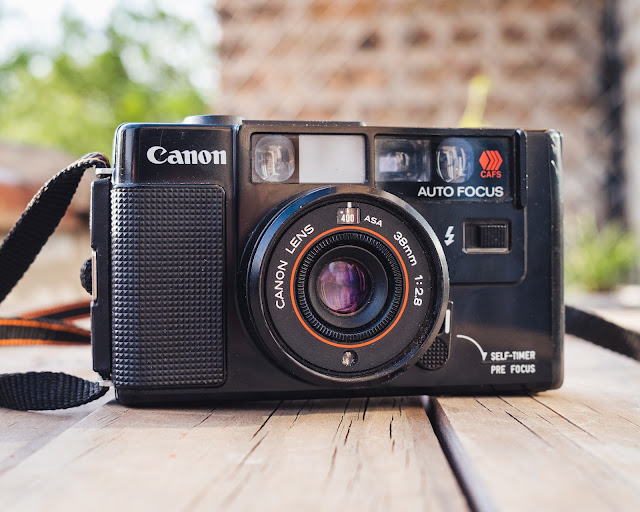
Spotlight: Canon AF35M


Last weekend I lucked out at the flea market and picked up this Canon AF35M for a measly five bucks! Needless to say, I was elated

Released all the way back in 1979, the AF35M is Canon's very first autofocusing camera. It uses an infrared system that works pretty well, even in low light. While not all of my photos came out sharp, the majority were acceptable, and for 1979, I consider that a win. 

I love early autofocus point-n-shoot cameras like this, because they usually had fast prime lenses, not like the plethora of 90's point-n-shoots with boring slow zooms. The 38mm f/2.8 lens on the AF35M is a great focal length for a fixed prime-- not too wide and not too tele. It's pretty dang sharp, too, if the focus is on point. 
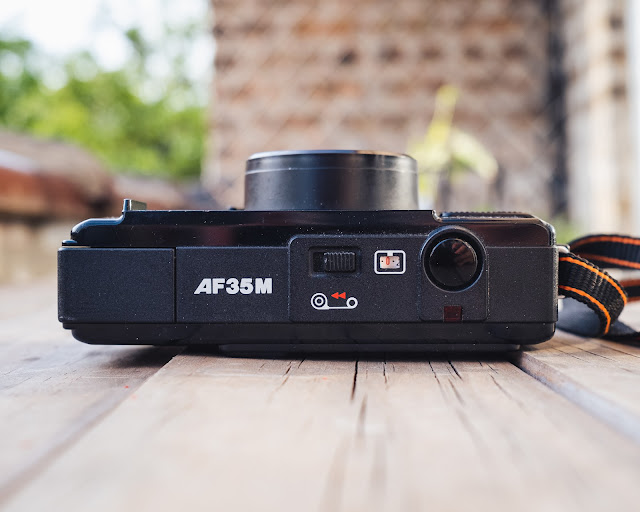
Loading the camera is a little awkward. Auto-load wasn't a thing yet for electronic cameras, so you still have to stuff the film leader into a take-up reel. Film also isn't automatically advanced to the first frame when you close the camera, so you gotta manually fire off three shots or so (until the frame counter reads 1). Also, the ISO must be set manually via a dial on the front of the lens -- no DX compatibility here! The camera can handle film speeds between 25 and 400. 

Once the camera is loaded and your ISO is set, the camera is very simple to use. It's a point-n-shoot, so exposure is completely automatic, with no manual override. I suppose you could change the ISO on the front of the camera to intentionally over or under expose, but the ISO dial does not turn easily, so it'd be a pain. Exposures, both with ambient light and flash, turned out basically perfect in my experience, so I wouldn't worry about the lack of control. Like, seriously, this 40+ year old point and shoot exposes more accurately that my DSLR. 

Exposures are made by pressing the massive shutter release button on top of the camera. The shutter can fire between 1/8 and 1/500 of a second. If you half-press the shutter, a red light will come on in the finder if the camera thinks the scene is too dark for handheld operation. There is also a distance scale in the finder, but it's almost useless. When you fire the shutter, a little indicator shows you the distance the lens focused at. While this is cool, I wish it happened BEFORE the picture was taken, and not after.  So, you'll have a good idea if the camera missed focus, but only AFTER you wasted a frame of film. The Nikon L35AF later fixed this issue by showing you the focus indicator when the shutter button was pressed halfway, before exposure. The AF35M's scale is better than nothing at all, but still disappointing.  

The viewfinder with focus point, distance scale, and frame lines


The camera will try to focus on whatever the center icon in the viewfinder is pointed at. If you want to shoot an off-center subject, it's a little tricky. You have to flip down the self-timer switch, press the shutter button to pre-focus, recompose, then finally press the shutter button again. This process is cumbersome, and pretty much requires you to use a second hand. There is also no way to cancel the exposure or change the focus once the shutter is pressed for the first time. Oof. 

Once an exposure is made, the camera automatically winds the film to the next frame with a charming "UURRRR!" noise. This camera is by no means quiet! At least the camera does not wind until you take your finger off the shutter button, so you can control when the camera screams. At the end of the roll, you must rewind the film by pressing the sprocket release on the bottom of the camera while simultaneously holding down the rewind switch on the top of the camera. It's a true test of dexterity! During rewinding, you are treated to a different, but equally pleasing "WUHoooWUHoooWUH" sound. The frame counter counts backward during the rewind phase, which is fun to watch. 


The only other feature to talk about is the flash, which does its job well. It's activated with a little switch on the front of the camera, which causes it to pop up and into action! It takes about four seconds to charge up with a pair of fresh AA batteries. Like I said before, the flash exposures turned out perfect. No blown out faces, even at close distances. 

While Canon's AF35M certainly has a lot of eccentricities, I found most of its issues excusable given it's one of the first autofocus cameras... ever. These point-n-shoots were primarily designed for capturing family moments, so that's what I did with mine. I mostly shot pictures while hanging out with friends and family, as well as the process of moving my brother-in-law into his new apartment. 


Friday, May 27, 2022

Print: Fortune Teller


A 7x5 print I made of a fortune teller automaton in Detroit, Michigan. I finally got my enlarger working properly thanks to a piece of heat absorbing glass, so I plan on making a lot more darkroom prints going forward!

Monday, May 16, 2022

Spotlight: Nikon F4s


I like the Nikon F4 quite a bit. I made a spotlight for it almost exactly five years ago, which can be viewed here. A couple days ago, at an estate sale, I found a Nikon F4s in great condition. Besides a thin little cosmetic crack on the viewfinder, it seems near-mint! 

So, what's the difference between an F4 and an F4s? Turns out, it's the battery pack. When the smaller MB-20 pack is installed on the camera body, it's known as an F4. When the beefier MB-21 pack is attached, the camera becomes an F4s. Besides these swappable battery packs, the cameras themselves are the exact same. 

While the F4s setup is larger than the standard F4, and takes an additional two batteries (6 vs. 4), you do get some cool added features. With all that extra battery power, the F4s can shoot at an impressive (for 1988) 5.7 frames per second, quite a bit faster than the 4 fps of the standard F4. Though the F4s is huge for a 35mm camera, the MB-21 does afford it a vertical grip, which makes framing portrait-oriented photographs much more pleasant. I actually prefer the handling of the F4s to the F4, as long as I don't have to carry it around with me very far! 


I took my F4s out with me to photograph what it was designed to photograph: sports. My vintage base ball team, the Chicago Salmon, had a game in Valparaiso this past weekend, and I captured some of it on film. Overall I was impressed with the results. As I was in daylight for the entire shoot, the autofocus worked very well. Most of my photographs came out acceptably sharp, and very well exposed. While I don't think the F4s could keep up with faster, more unpredictable sports like soccer or basketball, for baseball it definitely sufficed. 


There is one thing about the F4 that bugs me though, which is that it will not shoot at its fastest frame rate while in "single" autofocus mode. It will only shoot at the full 5.7 fps when in "continuous" or "manual" focus modes. At first I thought my new F4s was not working properly, but my other F4 operates the same way. I guess in "single" mode, the camera needs to make sure it is properly focused between each exposure, so it refuses to shoot at its fastest speed. Kind of annoying, but you can work around this by using the AF-L (autofocus lock) button while in continuous mode. It's just an extra button you have to press. 

Speaking of buttons, that's also one of the reasons why I love the F4s. It's the most advanced autofocus 35mm camera to not have an LCD screen. There is a physical switch or dial for every single function, which some people may hate, but I find engaging. While I like my F5, which is leaps and bounds above the F4s in terms of technology, I can't help but be drawn to the mini switchboard that is the top of the Nikon F4s. I love being able to see all the settings on my camera at a glance without having to dive into any menus, or even turn the camera on. No, the F4s is nowhere near as capable as the F5, but it has way more charm, and is more rewarding to operate. 


I originally intended to sell this F4s and make a quick buck, but I think I'll hold onto it for a while. Maybe I'll even shoot some more games with it. Enjoy the rest of the photographs I made with my F4s. I used a Nikon 80-200 f/2.8 D lens, and Ilford Delta 400 film. 


Friday, January 21, 2022

Dailies: Jan 15th - Jan 21st


More Salmon Portraits

This Winter, I was able to catch up and create a few more portraits of new and returning members of the Chicago Salmon Base Ball Club. All portraits are 6"x6", graphite pencil on bristol paper. 


Hoover

Gus Bus

Man Hands

Bully