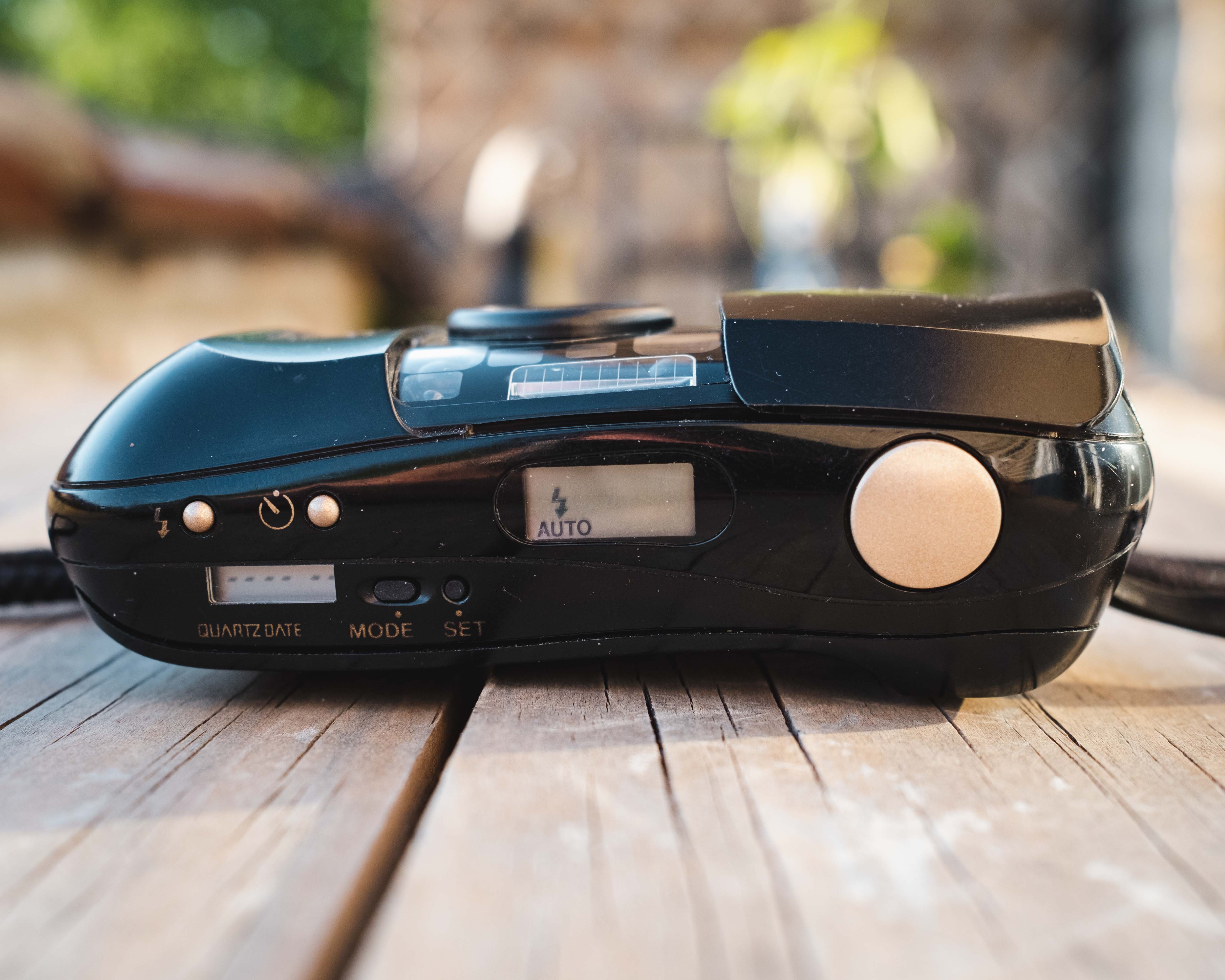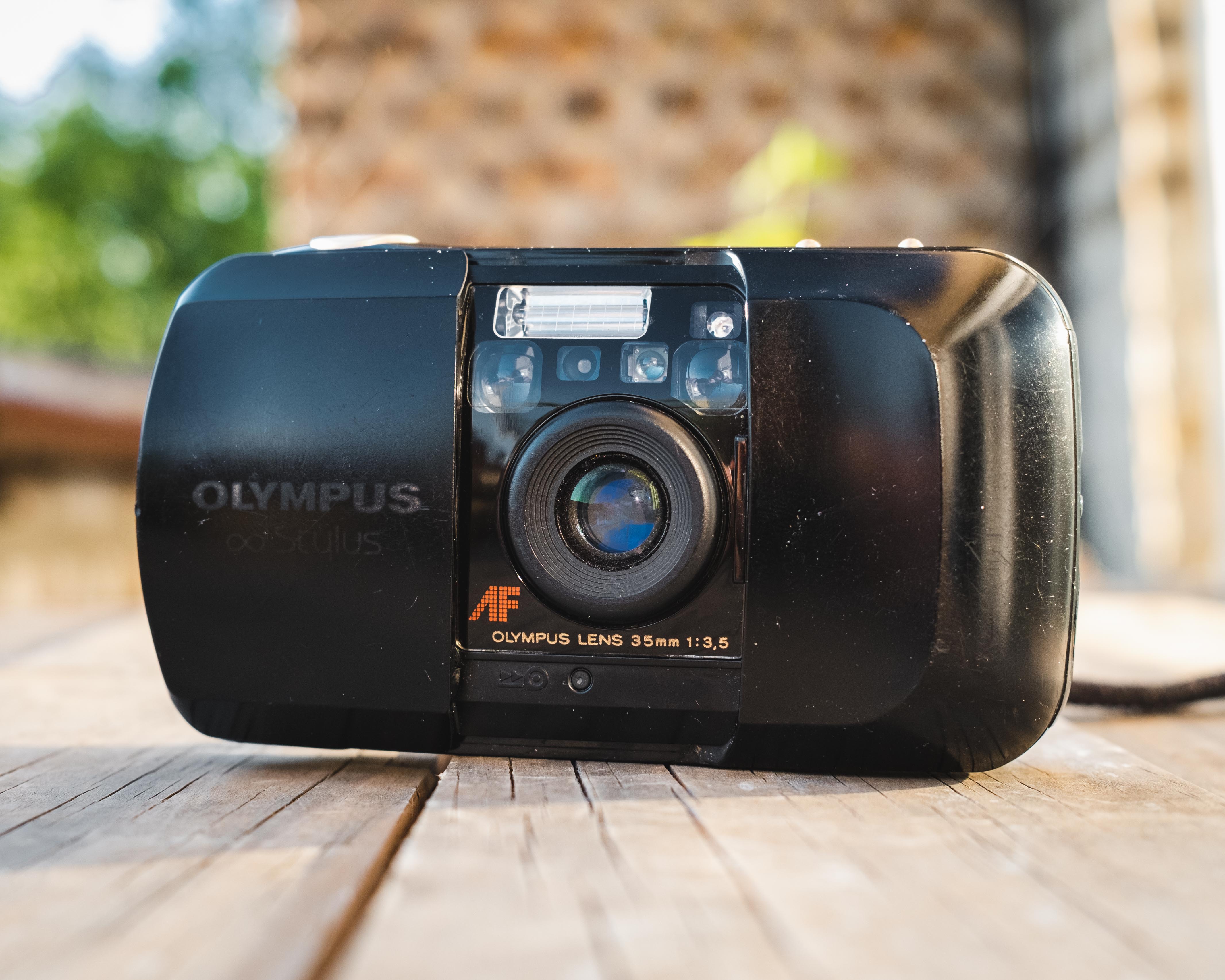
Operation of the Stylus is fully automatic. There is no exposure compensation feature -- you can't even manually change the ISO to trick the camera into over or under-exposure (the light meter relies on DX coded film). You do, however, get a good selection of flash modes. By default, the camera is set to auto, where the camera will decide for you whether the scene needs flash or not. Auto-S mode eliminates red-eye in color photos by emitting a mini rave's worth of flashes before the main flash. Fill-In mode is used to fill in harsh shadows when photographing outdoors in bright light, or if your subject is back-lit. I used this mode the most while photographing my baseball team outside in harsh afternoon light. You can also just turn off the flash entirely.
Wednesday, June 29, 2022
Spotlight: Olympus Stylus
Operation of the Stylus is fully automatic. There is no exposure compensation feature -- you can't even manually change the ISO to trick the camera into over or under-exposure (the light meter relies on DX coded film). You do, however, get a good selection of flash modes. By default, the camera is set to auto, where the camera will decide for you whether the scene needs flash or not. Auto-S mode eliminates red-eye in color photos by emitting a mini rave's worth of flashes before the main flash. Fill-In mode is used to fill in harsh shadows when photographing outdoors in bright light, or if your subject is back-lit. I used this mode the most while photographing my baseball team outside in harsh afternoon light. You can also just turn off the flash entirely.
Saturday, June 4, 2022
Spotlight: Canon AF35M
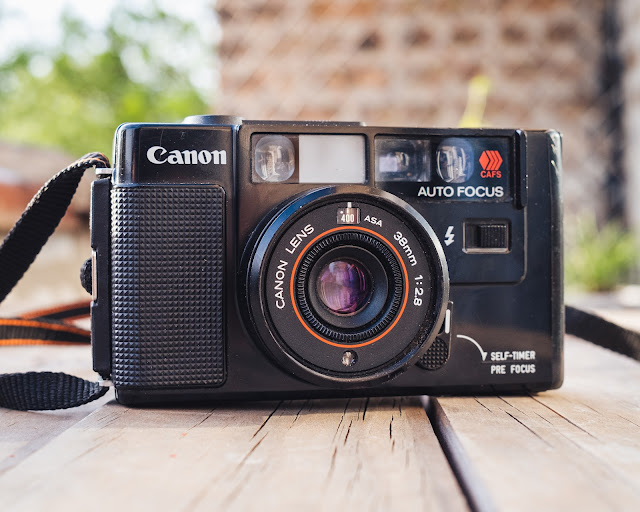
Last weekend I lucked out at the flea market and picked up this Canon AF35M for a measly five bucks! Needless to say, I was elated.
Released all the way back in 1979, the AF35M is Canon's very first autofocusing camera. It uses an infrared system that works pretty well, even in low light. While not all of my photos came out sharp, the majority were acceptable, and for 1979, I consider that a win.
I love early autofocus point-n-shoot cameras like this, because they usually had fast prime lenses, not like the plethora of 90's point-n-shoots with boring slow zooms. The 38mm f/2.8 lens on the AF35M is a great focal length for a fixed prime-- not too wide and not too tele. It's pretty dang sharp, too, if the focus is on point.
Loading the camera is a little awkward. Auto-load wasn't a thing yet for electronic cameras, so you still have to stuff the film leader into a take-up reel. Film also isn't automatically advanced to the first frame when you close the camera, so you gotta manually fire off three shots or so (until the frame counter reads 1). Also, the ISO must be set manually via a dial on the front of the lens -- no DX compatibility here! The camera can handle film speeds between 25 and 400.Once the camera is loaded and your ISO is set, the camera is very simple to use. It's a point-n-shoot, so exposure is completely automatic, with no manual override. I suppose you could change the ISO on the front of the camera to intentionally over or under expose, but the ISO dial does not turn easily, so it'd be a pain. Exposures, both with ambient light and flash, turned out basically perfect in my experience, so I wouldn't worry about the lack of control. Like, seriously, this 40+ year old point and shoot exposes more accurately that my DSLR.
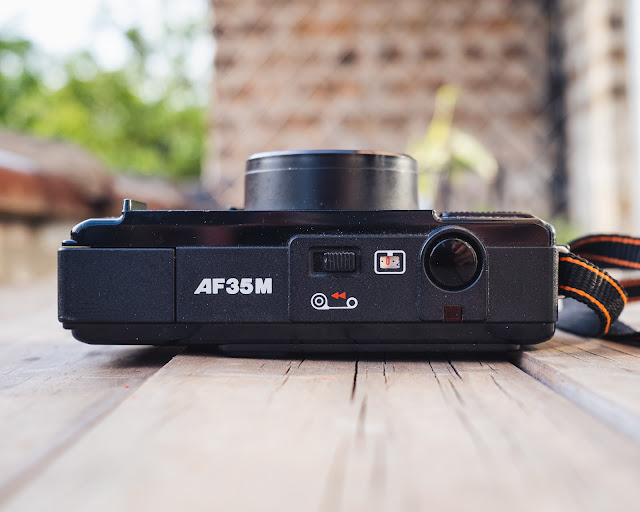
Exposures are made by pressing the massive shutter release button on top of the camera. The shutter can fire between 1/8 and 1/500 of a second. If you half-press the shutter, a red light will come on in the finder if the camera thinks the scene is too dark for handheld operation. There is also a distance scale in the finder, but it's almost useless. When you fire the shutter, a little indicator shows you the distance the lens focused at. While this is cool, I wish it happened BEFORE the picture was taken, and not after. So, you'll have a good idea if the camera missed focus, but only AFTER you wasted a frame of film. The Nikon L35AF later fixed this issue by showing you the focus indicator when the shutter button was pressed halfway, before exposure. The AF35M's scale is better than nothing at all, but still disappointing.
| The viewfinder with focus point, distance scale, and frame lines |
The only other feature to talk about is the flash, which does its job well. It's activated with a little switch on the front of the camera, which causes it to pop up and into action! It takes about four seconds to charge up with a pair of fresh AA batteries. Like I said before, the flash exposures turned out perfect. No blown out faces, even at close distances.
Friday, May 27, 2022
Print: Fortune Teller
Monday, May 16, 2022
Spotlight: Nikon F4s
I like the Nikon F4 quite a bit. I made a spotlight for it almost exactly five years ago, which can be viewed here. A couple days ago, at an estate sale, I found a Nikon F4s in great condition. Besides a thin little cosmetic crack on the viewfinder, it seems near-mint!
So, what's the difference between an F4 and an F4s? Turns out, it's the battery pack. When the smaller MB-20 pack is installed on the camera body, it's known as an F4. When the beefier MB-21 pack is attached, the camera becomes an F4s. Besides these swappable battery packs, the cameras themselves are the exact same.
While the F4s setup is larger than the standard F4, and takes an additional two batteries (6 vs. 4), you do get some cool added features. With all that extra battery power, the F4s can shoot at an impressive (for 1988) 5.7 frames per second, quite a bit faster than the 4 fps of the standard F4. Though the F4s is huge for a 35mm camera, the MB-21 does afford it a vertical grip, which makes framing portrait-oriented photographs much more pleasant. I actually prefer the handling of the F4s to the F4, as long as I don't have to carry it around with me very far!
I took my F4s out with me to photograph what it was designed to photograph: sports. My vintage base ball team, the Chicago Salmon, had a game in Valparaiso this past weekend, and I captured some of it on film. Overall I was impressed with the results. As I was in daylight for the entire shoot, the autofocus worked very well. Most of my photographs came out acceptably sharp, and very well exposed. While I don't think the F4s could keep up with faster, more unpredictable sports like soccer or basketball, for baseball it definitely sufficed.