This summer I'm working on making graphite pencil portraits depicting members of the Chicago Salmon vintage base ball club. These portraits will eventually be featured on the team website, chicagosalmon.org. Each portrait is 6" x 6".


This summer I'm working on making graphite pencil portraits depicting members of the Chicago Salmon vintage base ball club. These portraits will eventually be featured on the team website, chicagosalmon.org. Each portrait is 6" x 6".


Harbor Country is a series of photographs I plan to produce over the course of this summer and beyond.
For my entire life, my family has owned a small cottage in Union Pier, Michigan, and I spent every summer there through high school. Recently my wife and I have started to spend a lot of time in Union Pier, which has been phenomenal. However, I've noticed that a lot of places I frequented as a kid are now changed, abandoned, or completely gone. With Harbor Country, I seek to document the once familiar locations I associate with my childhood that have since been erased, no matter how seemingly insignificant.


The Nikon F5, released in 1996, is the ultimate professional 35mm SLR for sports and action. This camera does not mess around. It has a shooting speed of 7.4 frames per second, and weighs in at 3 pounds, 11 ounces with batteries, film, and a 50mm lens. The size and weight kept me away from the F5 for a long time, but I picked one up a few weeks ago to see how it fared shooting baseball.
I've owned my Nikon F, F2, and F4 cameras for many years now, and absolutely adore them. I enjoy their robust-yet-compact builds, and simplistic mechanical controls. The F5 is a departure from these previous F models, trading mechanical knobs for an electronic display and command dials. It's a very modern setup, one that digital SLR users will immediately be right at home with. Though the hipster in me misses physical controls, the electronic display does nicely streamline the shooting experience.


Overall I love the F5. While not a camera I see myself using a lot due to its size, I think I will keep it around for situations that call for its high frame rate and dependable autofocus. Below are a few more photographs I made with my F5 and 80-200mm f2.8 D lens, on Kodak Tmax 400 film.


Besides the ability to switch between formats, the Konica Auto-Reflex is a pretty standard 60's SLR. Shutter speeds (1~1/1000 + B) are selectable via a knob on the front of the body. There's a self-timer, which also locks up the mirror for less vibration, which is a nice touch. The viewfinder is frustrating for eyeglass users such as myself, as your eye pretty much has to touch the finder to see the entire focusing screen. With my glasses between my eye and the finder, I can probably only see about 3/4 of the frame. The focusing screen has decent brightness with a large microprism assist, and is not interchangeable. Build quality is about average. The Konica doesn't feel cheap, but it isn't nearly as robust as a Nikon or Pentax from the era.
Below are a few photographs I made with the Auto-Reflex P, using a 40mm f/1.8 Hexanon and Ilford Delta 400 film.


Popular Photography, 8" x 10", collage on wood board.
All of the collage material was taken from issues of photography magazines from the 1960's and 70's. The man in the upper left is Alfred Stieglitz, one of photography's first champions, and a notorious pervert (just read about his relationship with Paul and Rebecca Strand). The man on the right is the cover boy for Miranda camera, which featured a hyper-sexual ad campaign in the 60's that completely objectified women. While I'm happy that more women are getting recognized for their work behind the camera these days, we still have a ways to go.
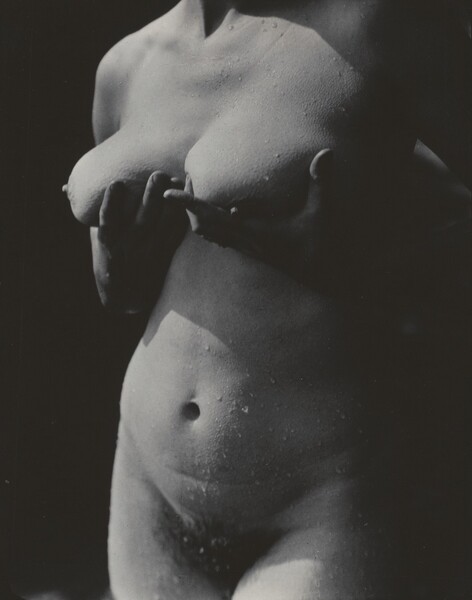
Alfred Stieglitz, Rebecca Salsbury Strand, 1922


Miranda Camera Advertisements, 1960's