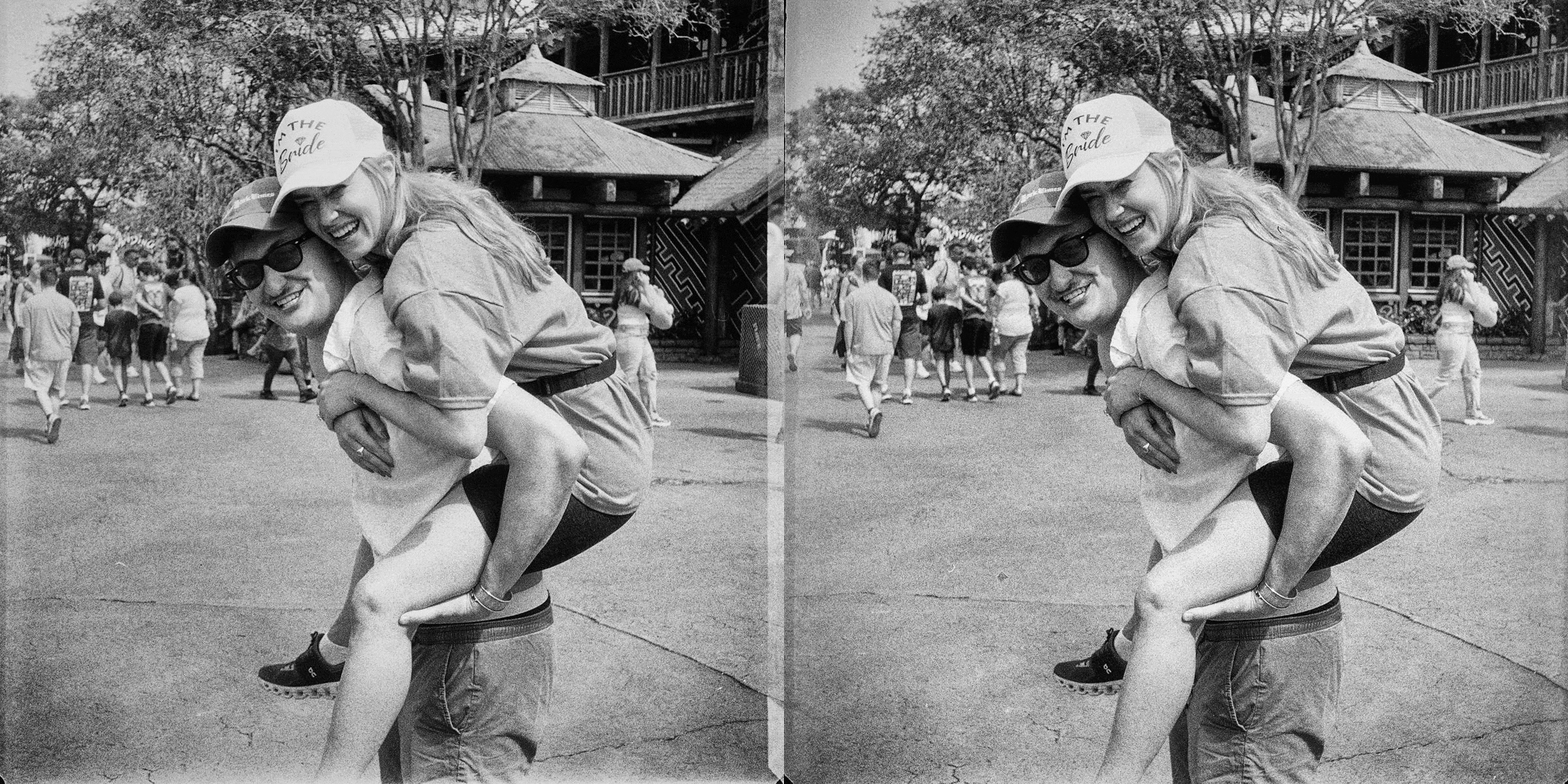
Last month my brother, Pearson, got married! The wedding was near Portland, Maine. Below are some photos from the trip. I shot three rolls of bulk-loaded Ilford HP5+, two on my Nikon F and one on my Olympus XA.


Last month my brother, Pearson, got married! The wedding was near Portland, Maine. Below are some photos from the trip. I shot three rolls of bulk-loaded Ilford HP5+, two on my Nikon F and one on my Olympus XA.


The Miranda Camera Company gets a lot of flack, if it's even remembered in the first place. Most photographers don't know about Miranda cameras, which is understandable since the company went under forty-five years ago. I've always had a mild interest in Miranda, partly because of their ridiculous advertising campaign that could be mistaken for softcore pornography while flipping through a vintage camera magazine. That said, the only model I'd previously used of theirs was the Sensorex, a camera I enjoyed and have since lent out to students in my darkroom classes. Hungry for more, I asked an older local dealer if he had any Mirandas, and the man (his name's Howard) made a face like he just sipped months-old milk. "Why do you want one of those?" Howard asked.

The 1963 Miranda F was the first Miranda to feature automatic aperture diaphragm control built into the camera body. Before the F, you needed to buy lenses that had automatic diaphragms, or otherwise stop the lens down manually before exposures (a horribly tedious process). The 1967 Fv model that I have is pretty much identical to the original F, but with a removable shutter speed dial that you can replace with an optional light meter accessory.

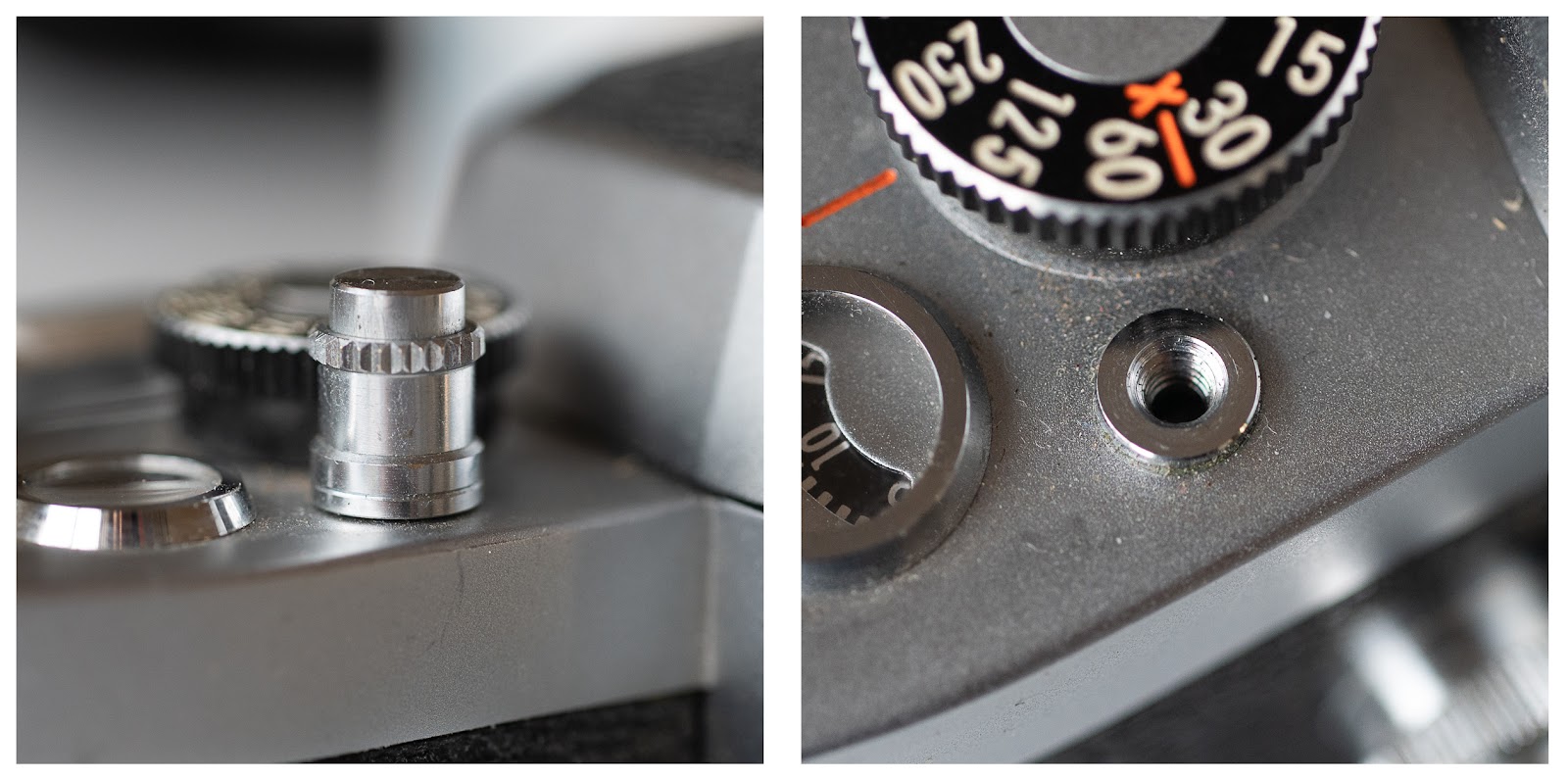
The camera is entirely mechanical. Shutter speeds cover the standard 1 second to 1/1000th range, plus bulb. The focusing screen has a central microprism assist, and is fixed. The microprism spot really pops when your subject comes into focus, but the screen as a whole is not exceptionally bright. There is no hot shoe on the standard finder, but the camera has sync ports for X and FP flashes. The Fv has no self-timer, mirror lock-up, or multiple exposure functions. Similar to Olympus OM cameras, aperture preview is located on each individual lens.
The Fv's frame counter deserves a special mention. Its circular glass window radiates class, but the best part is the frame indicator. When the shutter is cocked, the indicator turns orange. After exposure, the indicator turns black. It's a very cool way to tell if the camera is ready to fire or not!

Build quality is good, but not on the same level as, say, a Nikon or a Pentax. My main complaint is that lenses do not fit 100% snug in their mount, and jiggle a tiny bit while focusing or changing aperture. The non-ratcheted advance lever feels cheap, and has a long throw. Long-term reliability also seems to be a problem with Miranda cameras in general, as most of the Mirandas I find in the wild are non-functional. My Fv is fully working, aside from a bit of shutter capping at 1/1000.
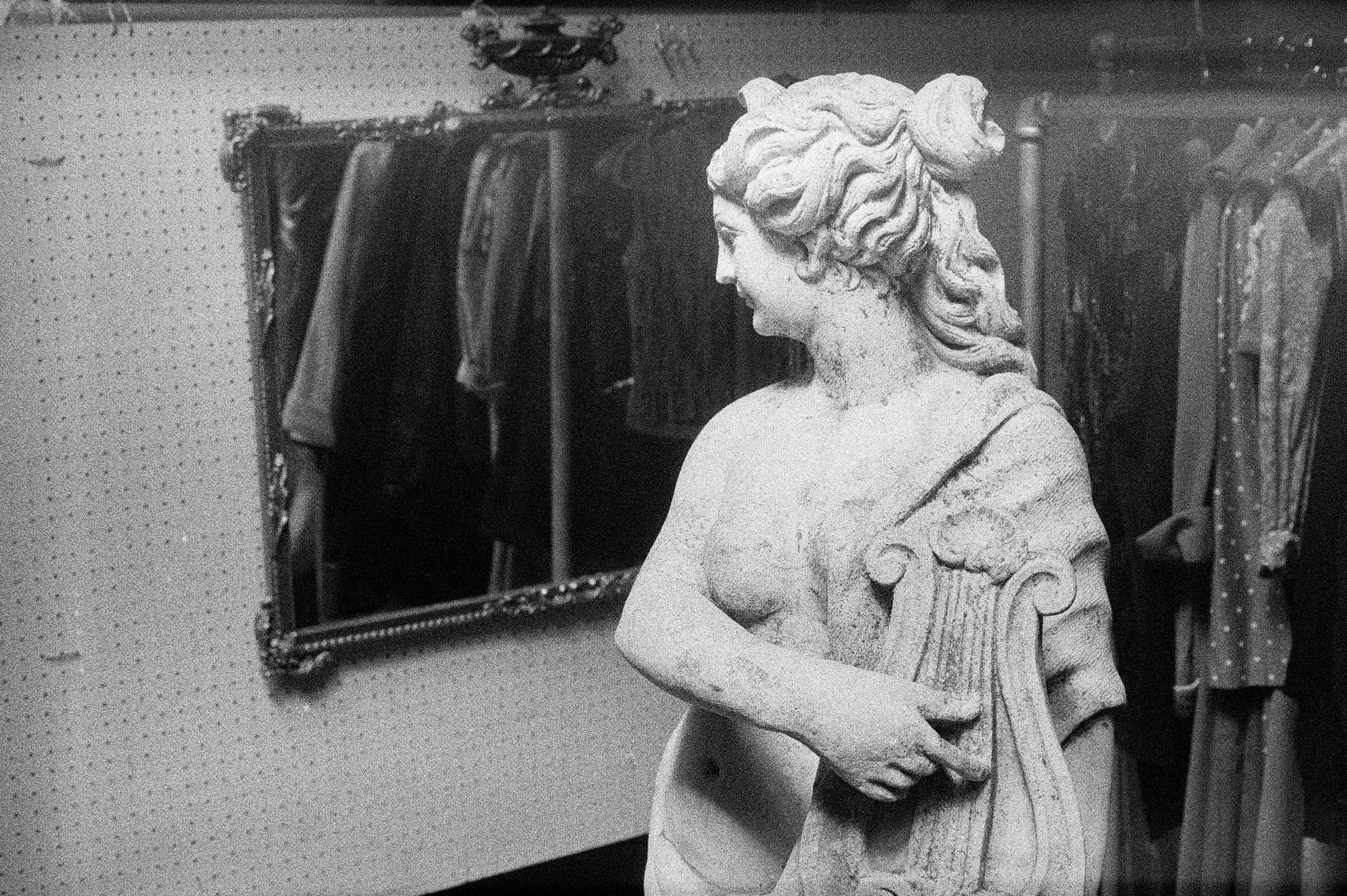
Overall I like the Miranda Fv. Unique features like swappable finders and double the shutter releases make it more interesting than the average consumer-level SLR. If you can find an example in working condition, I recommend picking it up! Below are some photos I made with my Miranda Fv. The lens was a 50mm f/1.8 Auto Miranda EC, and the film was Ilford HP5+. Thanks for reading!




 |
| The left window is for focusing, while the right is for composing |
Unfortunately, the Revere Stereo 33 does not have a standard hot shoe, nor does it have a sync port for attaching a flash. My workaround is with a Vivitar 283 flash, which sets its flash output automatically based on your camera's aperture setting. I match the output level on the flash with the aperture setting on the camera (usually f/16 so not too much ambient light gets in), start a bulb exposure, fire the flash manually using the test button on the back, then finish the bulb exposure. It's a pain for sure, but it works.
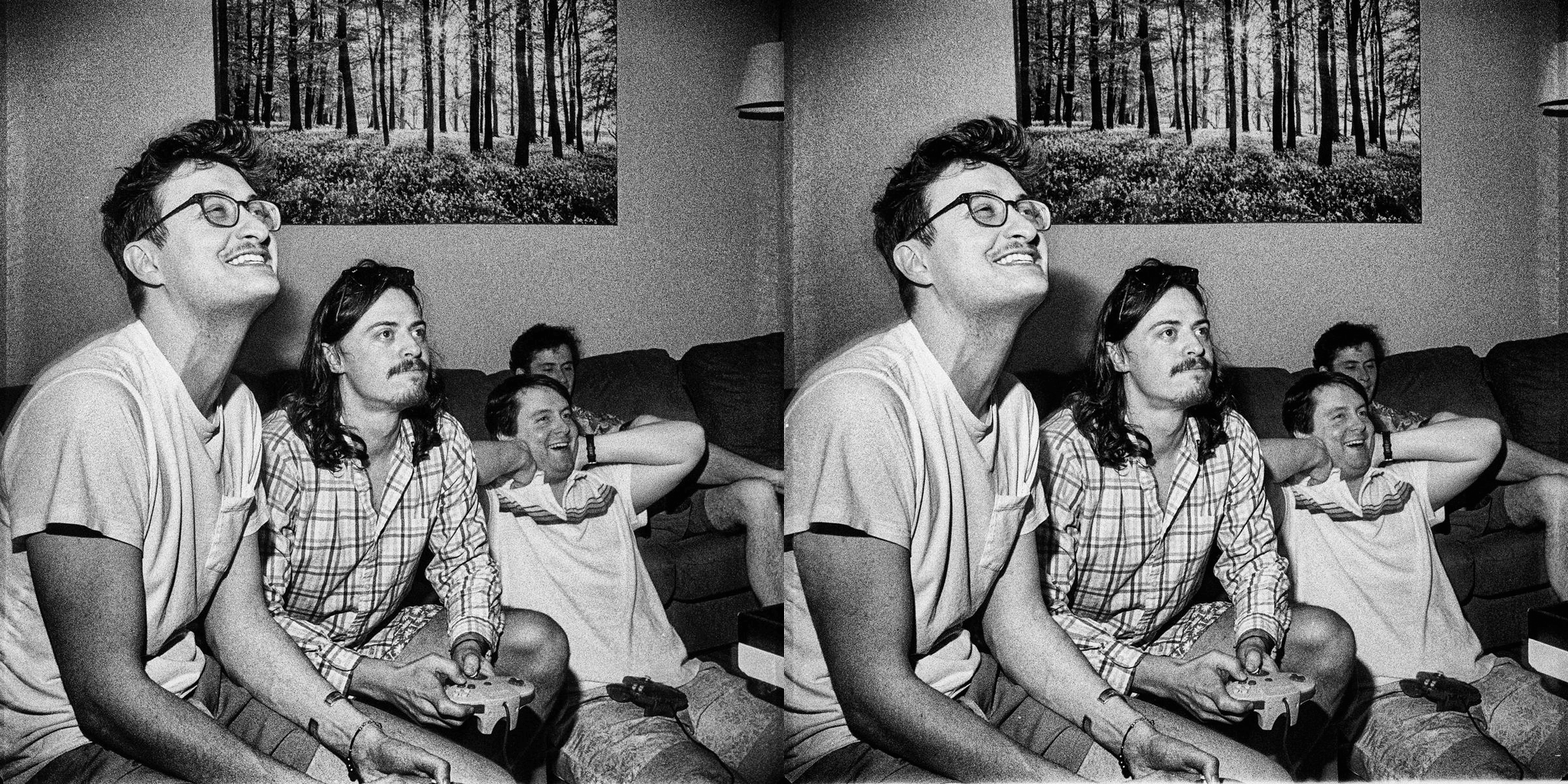
But yeah, overall I love the Revere Stereo 33. I've yet to find a 35mm stereo camera that is easier to use, or one that has more precise focusing. I plan on doing a lot more stereo work with this camera over the summer. Below are some stereo pairs that I made documenting my brother's big bachelor weekend. Unfortunately it's very difficult to see the 3-D effect without a viewer, but if you stare past the center of the pair, you can sometimes trick your eyes into seeing a 3-D image. It's also somewhat effective if you flip rapidly between the left and right eye images using a GIF, but in my experience, this doesn't work with every stereo image. The film was bulk-loaded Ilford HP5+.



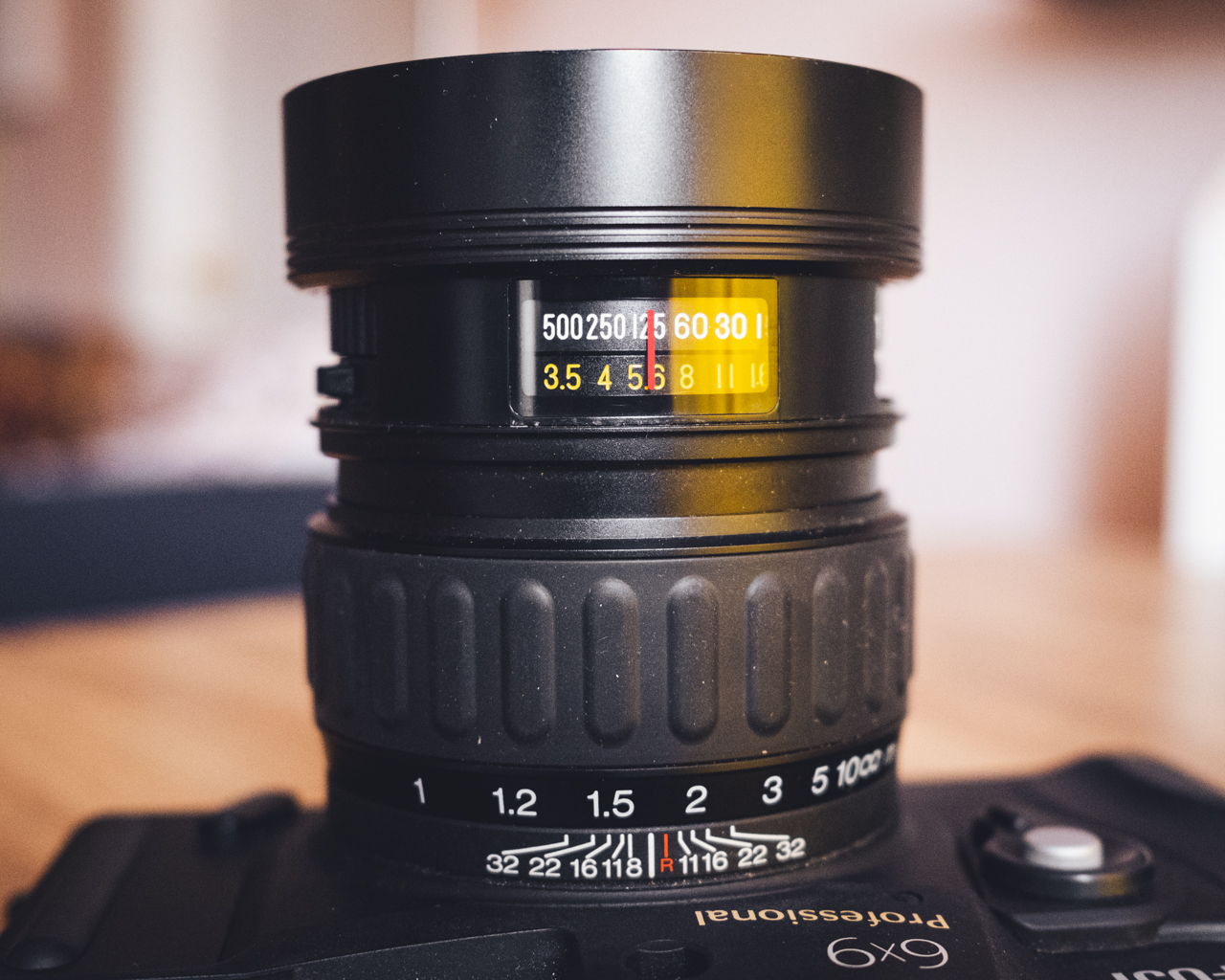
A few weeks ago I was in Galesburg, Illinois for an art opening, where my friend Tom was kind enough to lend me his newly purchased Fujifilm GW690III Professional camera for a day. Released in 1992, the GW690III is the third and final 6x9 medium format rangefinder camera that Fujifilm produced in the GW line. It's completely mechanical, and doesn't even have a light meter, not that a Professional (a la the camera's moniker) would require a light meter, anyways. I don't understand why Fujifilm included the Professional subtitle under so many of their cameras. It's honestly a bit cringe -- like they're pleading with professional prhotographers to buy their cameras.
Anyway, the GW690III is a complete beast of a rangefinder. I mean, as one might expect from a camera that produces a 6x9 negative, the thing is frickin' huge. That said, though, it isn't too heavy (I think it's made from some high-quality plastic), and it's not really a pain to carry around if you have a decent strap or bag. I took Tom's camera around with me to a few different bars and barely noticed it slung around my shoulder. The grip on the camera is comfy, and there are even two different shutter releases-- one on the top of the camera, and one on the front. Not really sure why the extra release is necessary, but it's pretty cool!
Aperture and shutter speed are both controlled via two dials around the tip of the lens, and are easily adjustable with your left hand. Unlike some dumb German and Swedish cameras, the shutter speeds and apertures thankfully don't interlock. The lens is a fixed 90mm f/3.5 lens, which with the 6x9 format, provides roughly a 40mm field of view in 35mm terms. It's a great angle of view, perfect for general photography. The lens focuses as close as 1 meter, which is pretty par for the course when it comes to rangefinders. I was impressed by the sharpness of the lens, though I did pretty much only shoot in the middle of the aperture range.

Once again, I am impressed with the image quality of this 6x9 monster. It sucks that you only get eight shots per roll, but each frame is packed with incredible detail. The negatives are so big, that even just the contact prints are big enough to display and frame. I loved trying this camera out, and am thankful to Tom for trusting me with his new toy. We had a lot of fun at the bars in Galesburg drinking drafts and talking about photography. Below are a few photos I took on that night, as well as a couple of shots taken the next morning. The flash was a Vivitar 283, and the film was Ilford HP5.


Released in 1978, the Canon A35F is a fun little auto-exposure rangefinder camera, and one of the first Canon cameras to feature built-in flash. I bought mine as part of a huge lot of cameras from an auction, and decided to test it out before selling it.
The A35F comes equipped with a fairly fast and decently sharp 40mm f/2.8 lens. 40mm is my personal favorite focal length, providing a standard, if ever-so-slightly wide field of view that I find to be extremely versatile. At f/2.8, the A35F can give you some nice shallow depth of field -- not that you have much control over the aperture of the lens, since the camera is entirely automatic.
 |
| The viewfinder! |

Overall, the A35F is an enjoyable camera to use for casual snapshots. The only annoying thing about it is that it takes those old 1.35 volt mercury cells, which are not available anymore. Instead, I used an Exell 1.35-Volt Zinc Air Coin Cell Battery, which can be bought off Amazon here. The A35F was soon replaced a year after its release by the high tech autofocusing AF35M camera (which I looked at here), so the poor A35F is rarely talked about these days. That said, if you want a fun point and shoot with manual focus control, the A35F could be the camera for you! Below are a few photos I made with the A35F at my sister-in-law's birthday party. The film was Ilford HP5+.
Thanks for looking!